
By Fatima Saka
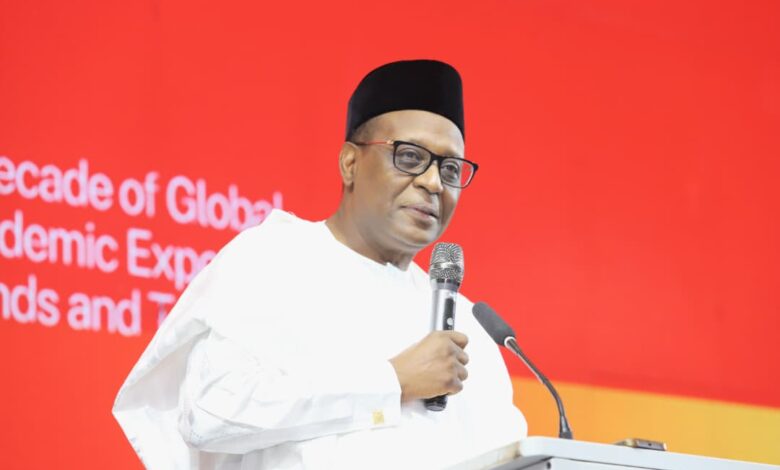
The Coordinating Minister of Health and Social Welfare, Muhammad Ali Pate, has declared that public health security is now central to national and economic stability, calling for urgent global action to strengthen pandemic preparedness and integrated health systems.
Speaking at a high-level international webinar involving experts from China and across Africa, Pate emphasized that the increasing threat of infectious diseases demands proactive strategies, stronger collaboration, and sustained investments in resilient health systems.
“It is not a question of if another pandemic will occur, but when,” he said, noting that infectious diseases—from HIV/AIDS and SARS to Ebola and COVID-19—have consistently shaped human history.
The minister highlighted a recent scientific study in North-Central Nigeria which detected antibodies to high-risk pathogens, including Ebola and coronaviruses, in wildlife populations—an indication of persistent zoonotic risks.
“This finding underscores the deep interconnection between the environment, livestock, agriculture, and human health. Pandemics do not start overnight—they begin as localized outbreaks before expanding into global crises,” Pate stated.
He emphasized that public health security must now be viewed as a critical component of national and economic stability.
“Public health security is economic security, and it is also national security. COVID-19 demonstrated how vulnerabilities in one region can disrupt the entire global system,” he said.
Pate further underscored Nigeria’s adoption of the One Health approach, which integrates human, animal, and environmental health systems to strengthen disease prevention and response.
“We are building a unified system that connects all sectors, ensuring early detection and rapid response to emerging threats,” he added.
Reflecting on Nigeria’s response to previous health emergencies, including the 2014 Ebola outbreak, the minister noted that strong institutions and coordinated leadership remain vital.
“We have learned critical lessons, particularly the importance of coordinated national response systems and resilient public health institutions,” he said.
He disclosed that the Federal Government is investing in healthcare infrastructure, including the expansion of teaching hospitals, establishment of specialized institutes, and approval of a National Institute of Public Health and Infectious Diseases.
In addition, Pate highlighted efforts to strengthen Nigeria’s healthcare value chain through financial initiatives supporting local pharmaceutical manufacturing and industrial growth.
“We have already supported over 16 major industrial partners, with more in the pipeline, to boost local production of essential health products,” he revealed.
The minister also stressed the importance of scientific research and innovation in driving health sector development.
“We cannot industrialize in the absence of sound science. That is why we are strengthening research governance, expanding clinical trial platforms, and building a robust scientific ecosystem,” he said.
On digital transformation, Pate noted that Nigeria is leveraging data systems and analytics to enhance disease surveillance and evidence-based decision-making.
“We are developing platforms that harness digital innovation to strengthen our health systems and improve response mechanisms,” he added.
He also called for greater community engagement and public trust, particularly in combating misinformation during health crises.
“In an era of misinformation, trust is critical. Communities must be actively engaged to respond appropriately during emergencies,” he noted.
Pate paid tribute to frontline health workers, describing them as the backbone of pandemic response efforts.
“Our frontline workers must be protected, supported, and equipped—they are essential to both national and global health security,” he said.
Reaffirming Nigeria’s commitment to international cooperation, the minister said collaboration with countries like China remains crucial in addressing global health challenges.
“Pandemics know no borders. By working together and learning from each other’s experiences, we can better prepare for future health emergencies,” he stated.
The webinar also featured a keynote presentation by Yongli Gao, a renowned biologist and former leader in China’s disease control system, whose insights on managing large-scale public health crises enriched the discussions.
READ ALSO: Next Pandemic Is Not a Question of If, But When — Dr.Salako Warns
Rebuilding Futures: VCDF, Lagos State and SEEPCO Revitalise Obele Community Schools
Pate concluded by urging the global community to move beyond reflection to decisive action.
“We must ensure that the lessons from past pandemics guide our policies, investments, and preparedness strategies. The time to act is now,” he said.
About The Author