By Fatima Saka
The Federal Government has warned that another global pandemic is inevitable and called for stronger collaboration between Nigeria and China to bolster preparedness and response systems.
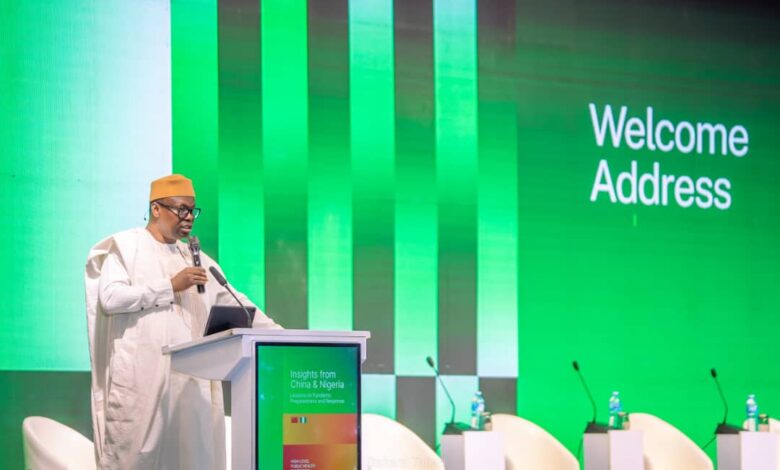
Speaking at a public health symposium in Abuja on Monday, the Minister of State for Health and Social Welfare, Dr. Iziaq Adekunle Salako, stressed that the world must act decisively to avoid repeating the devastating consequences of the COVID-19 pandemic.
The symposium, themed “Lessons on Pandemic Preparedness and Response: Insights from China and Nigeria,” brought together policymakers, health experts, and international partners at the Transcorp Hilton Abuja to assess global readiness for future health emergencies.
Salako described pandemics as “one of the most disruptive and brutal killers in human history,” noting that global consensus now points to the likelihood of another outbreak within the next five to eight years. He warned that declining public health funding could further weaken preparedness if urgent steps are not taken.
Reflecting on the impact of COVID-19 between 2020 and 2023, the minister said the pandemic exposed deep vulnerabilities in global health systems, with over seven million deaths recorded worldwide. He noted that while the crisis strained Nigeria’s health infrastructure and economy, coordinated national efforts, strong leadership, and international support enabled the country to respond relatively effectively.
He also highlighted China’s response to the outbreak, praising its rapid containment measures, technological integration, and community mobilisation, which were acknowledged by the World Health Organization. According to him, both countries now have valuable lessons to share in strengthening global health security.
Salako emphasised that Nigeria has continued to improve its pandemic preparedness since COVID-19, citing the digitalisation of disease surveillance through the Surveillance Outbreak Response Management and Analysis System (SORMAS), expansion of laboratory networks, and establishment of public health emergency operations centres across all states and the Federal Capital Territory.
He disclosed that Nigeria’s health security capacity has improved significantly, with the country’s performance score rising from 39 percent in 2017 to 54 percent in 2023 based on a Joint External Evaluation.
The minister further noted that under the administration of President Bola Ahmed Tinubu, health security has been prioritised as a key pillar of the Health Sector Renewal Investment Initiative. He said efforts are underway to strengthen state-level preparedness through integrated surveillance targets and a “One Health” approach linking human, animal, and environmental health systems.
Salako added that Nigeria is actively participating in ongoing negotiations for a global pandemic agreement coordinated by the World Health Organization, reaffirming the country’s commitment to multilateral cooperation.
READ ALSO: Rebuilding Futures: VCDF, Lagos State and SEEPCO Revitalise Obele Community Schools
AIG Jimoh Declares Zero Tolerance for Corruption, Rights Abuses in Lagos, Ogun
He urged stakeholders to adopt a whole-of-society approach to pandemic preparedness, involving governments, the private sector, researchers, and communities, while calling for a broader strategy that goes beyond medical responses to include social and cultural dimensions.
The minister expressed optimism that insights from the Nigeria-China collaboration would help build a more resilient global health system capable of preventing, detecting, and responding effectively to future outbreaks.
About The Author