
By Fatima Saka
The Federal Government has intensified its call for Nigerians to pay greater attention to technology adoption, as top officials outlined how investments in digital and space infrastructure are central to achieving national development goals.
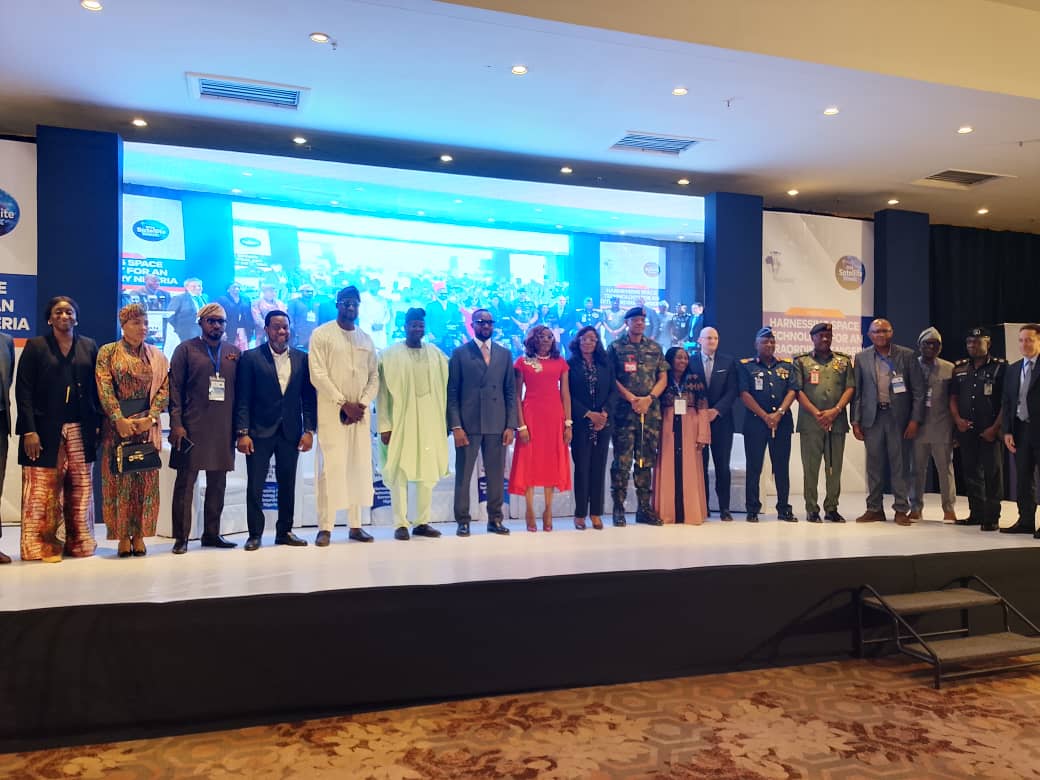
Speaking at the Satellite Week on Monday in Abuja themed “Harnessing Space for an Extraordinary Nigeria,” the Minister of Communications, Innovation and Digital Economy, , underscored the strategic importance of space technology in driving Nigeria’s digital economy.

Tijani said the administration of President has demonstrated strong political will by prioritising infrastructure that supports long-term economic growth. He noted that the approval of NigComSat 2A and 2B reflects a deliberate effort to modernise Nigeria’s satellite capabilities and position the country as a leader in the region.
The minister explained that satellites are not abstract or distant technologies but practical tools that directly impact everyday life.
“The digital economy we seek cannot be achieved without strong infrastructure. Satellite technology sits at the centre of this transformation, impacting education, agriculture, security and business operations,” Tijani said.
According to him, they enable internet connectivity in rural communities, support farmers with data for precision agriculture, enhance emergency response systems, and improve business operations across distances.
He further highlighted Nigeria’s broader digital infrastructure plan, including the rollout of 90,000 kilometres of fibre optic cables and thousands of telecom towers, noting that these investments are designed to work together to create a resilient and inclusive digital ecosystem.
Tijani also emphasised the need for Nigerians, particularly innovators and entrepreneurs, to build solutions on top of government-provided infrastructure, warning that investment alone would not yield results without active utilisation.
I her remarks, The Managing Director and Chief Executive Officer of Nigerian Communications Satellite (NigComSat) Jane Egerton-Idehen, provided operational insights into Nigeria’s satellite programmes and their real-world applications.
She revealed that NigComSat has been instrumental in delivering connectivity to remote and underserved communities through initiatives such as Project 774, which targets nationwide digital inclusion.
She added that the agency also plays a major role in broadcasting and broadband services, positioning it as a critical national asset.
Egerton-Idehen disclosed that the procurement process for NigComSat 2A and 2B has progressed to the financing and implementation stage, with 2A expected by 2028. She explained that the satellites will enhance Nigeria’s ability to secure its borders and support neighbouring countries through expanded coverage.
According to her, one of the key advantages of satellite technology is its ability to provide real-time communication and intelligence gathering for security agencies, regardless of terrain or infrastructure limitations.
She noted that this capability is particularly crucial for operations in remote and border areas.
She also highlighted the role of satellites in agriculture, explaining that large-scale farms located in remote regions can leverage satellite-enabled connectivity for precision farming, including soil monitoring, crop tracking, and data-driven decision-making.
Also speaking, the Director-General and Chief Executive of the NASRDA (National Space Research and Development Agency , Dr. Matthew Adepoju, focused on Nigeria’s growing capacity in space science and technology.
Adepoju disclosed that the country has built a strong human capital base, with over 300 PhD holders and thousands of professionals contributing to research and development in the sector. He said the agency is committed to developing indigenous capabilities in satellite design, manufacturing, and launch systems.
He further revealed that the Federal Government has approved multiple satellite projects, including both communication and earth observation satellites, as part of efforts to strengthen Nigeria’s presence in the global space economy.
The NASRDA boss stressed that the future of the space sector lies in private sector participation, noting that government agencies alone cannot drive the level of innovation and investment required.
He called on Nigerian entrepreneurs and investors to take advantage of opportunities in the space ecosystem.
READ ALSO: Foreign Affairs Minister Tuggar Resigns to Pursue Bauchi Governorship Bid
Kalu Advocate for‘Digital First Governance’ as Cornerstone of Nigeria’s Public Sector Reform
Collectively, the speakers emphasised that while Nigeria has made significant progress in building infrastructure, the next phase requires collaboration across government, industry, and academia to fully harness the benefits of space technology.
They reiterated that technology, particularly satellite infrastructure, will play a decisive role in achieving Nigeria’s ambition of becoming a trillion-dollar economy, urging citizens to actively engage with and leverage these advancements.
About The Author