
The Commonwealth of Nations has formally adopted Nigeria’s NextGen Innovation Challenge for implementation across its 56 member countries, marking a major global endorsement of a homegrown Nigerian innovation model and positioning the country as a key driver of multinational technology and entrepreneurship collaboration.
The programme, pioneered by the National Board for Technology Incubation (NBTI), Nigeria’s lead agency for transforming ideas into industries, will officially debut outside Africa in 2026, with Barbados and Antigua selected for the inaugural Caribbean rollout. Multiple international funding partners are also preparing to support the initiative, signalling growing confidence in the programme’s capacity to deliver measurable economic impact.
Director General and Chief Executive Officer of NBTI, Dr. Kazeem Kolawole Raji, described the Commonwealth-wide adoption as a strategic expansion that reinforces South–South cooperation, cross-border knowledge exchange, and shared innovation frameworks among both developing and developed economies.
According to him, the expansion reflects a deliberate shift toward inclusive innovation that recognises talent and solutions emerging from diverse regions rather than concentrating on a single global innovation hub.
He noted that the programme positions innovation as a shared economic growth tool capable of addressing common challenges such as healthcare delivery, climate resilience, digital transformation, and sustainable development across Commonwealth nations.
Raji explained that with international funding partners indicating readiness to participate, the initiative is expected to unlock new capital flows, technical assistance, and access to global markets for innovators across member states.
He added that beyond funding, the programme strengthens the Commonwealth’s relevance in global technology and sustainability discourse, repositioning it as an active enabler of next-generation solutions rather than a passive diplomatic bloc.
As preparations intensify for the 2026 rollout, Raji said the NextGen Innovation Challenge is increasingly being viewed as a Commonwealth-backed innovation infrastructure, designed to convert ideas into scalable ventures and translate regional collaboration into tangible economic outcomes.
He outlined the strategic objectives for NextGen 2026 to include mobilising significant capital and foreign direct investment for Nigeria and other emerging markets, positioning Nigeria and partner countries as credible sources of global innovation, strengthening innovation diplomacy through engagements in London, Doha, and North America, and moving innovators beyond prototypes to market-ready solutions.
Expected outcomes of the programme include a higher number of investment-ready startups, measurable capital commitments, increased global visibility for Nigerian and African innovation, sustained mentorship and incubation pipelines, and long-term public-private-international collaboration models.
Declaring that the initiative has outgrown its early-stage status, Raji said NextGen is now a global innovation platform designed to scale ideas, unlock capital, and deliver real economic impact.
READ ALSO: U.S. Introduces Refundable Visa Bond to Curb Overstays, Raising Travel Costs for Nigerians, Others
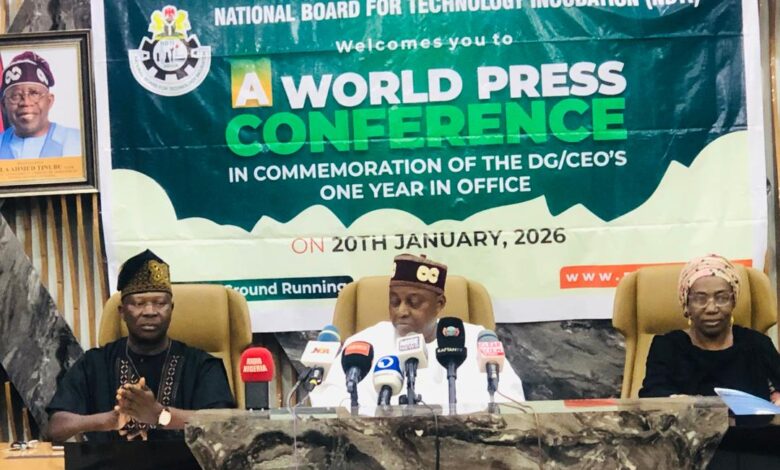
Reflecting on his first year in office, he stated that while the journey has only begun, NBTI has regained institutional confidence, innovators have renewed hope, and Nigeria has gained momentum in building a competitive innovation economy.
He reaffirmed his commitment to President Bola Tinubu’s vision, the Nigeria First Policy, and the development of an innovation-led economy that creates jobs, exports solutions, and secures the nation’s future.
About The Author