Sterling Leads Partnership, Trains 40 Journalists to Strengthen Media Sustainability in Nigeria

By Fatima Saka
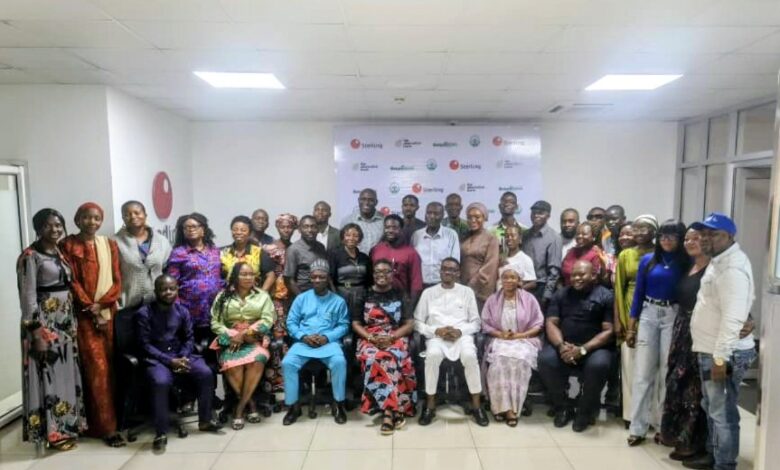
A total of 40 journalists from across different beats in Abuja have received intensive training on sustainability reporting, media innovation and artificial intelligence with the effort of Sterling Financial Holdings Company deepens its commitment to strengthening the media’s role in nations development.
The two-day training, which commenced on Tuesday, is organised by Sterling Financial Holdings Company and its subsidiary in partnership with the Climate Africa Media Initiative and Centre (CAMIC), Nature News to commemorate the 2025 National Sustainability Week.
The programme, designed to equip journalists with practical tools for sustainability, focused on storytelling, underscores Sterling’s belief that sustainable development cannot thrive without a resilient, innovative and financially viable media ecosystem.
Sterling Financial Holdings Company operates as a diversified group comprising Sterling Bank and The Alternative Bank, Nigeria’s foremost non-interest bank. The group’s sustainability agenda is driven by the Sterling Sustainability Working Group, a cross-functional body that champions sustainability initiatives across all subsidiaries.
Speaking at the training, the former Managing Director and Editor-in-Chief of Daily Trust Newspaper, Mallam Akogun Isiaq Ajibola, delivered a keynote lecture titled “Media Sustainability, Innovation and Nigeria’s Future.”
He challenged media organisations to urgently embrace technology and digital innovation as a pathway to financial survival and relevance.
“Media sustainability is no longer a theoretical concern; it is an existential issue,” Ajibola said. “The survival of journalism as a public good now depends on how well media organisations can adapt their business models, rebuild public trust, diversify revenues, and remain professionally independent while financially viable.”
He identified financial, editorial, institutional, and audience (readers and listeners) sustainability as critical pillars the Nigerian media must strengthen to remain relevant in agenda setting and democratic discourse.
On the application of artificial intelligence in journalism, the Editor of the International Centre for Investigative Reporting (ICIR), Victoria Bamas, facilitated a session titled “AI for Content Optimisation and Distribution.” She exposed participants to the growing opportunities AI presents in enhancing newsroom efficiency and storytelling.
Bamas noted that AI tools can support written, visual and audio content creation, automated news writing for areas such as sports and financial reporting, transcription and translation, brainstorming, source mapping, and data analysis for trend spotting.
“AI has become indispensable in today’s modern media environment,” she said, stressing that journalists who fail to adapt risk being left behind in a rapidly evolving digital landscape.
Also addressing participants, on Media Ethics and AI Risks, Publisher of NatureNews Media, Aliu Akoshile, highlighted concerns around AI-generated content, authorship and credibility. He emphasised that while AI can enhance productivity, journalists must retain critical thinking and ethical judgment to safeguard the integrity of the profession.
“The tool must never replace the journalist’s conscience,” Akoshile warned, adding that ethical responsibility remains paramount even in an AI-driven newsroom.
Earlier, delivering a goodwill message, Chair of the Sterling Sustainability Working Group, Mrs. Bunmi Ajiboye, described the training as more than a learning session, but a strategic investment in how Nigeria’s sustainability story is told.
“This training goes beyond capacity building; it is a cornerstone of how Nigeria tells her story of progress, resilience and innovation,” Ajiboye said. “The work is important, but the story is what shapes the nation.”
She noted that Sterling’s sustainability journey has been deliberate and impact-driven, spanning renewable energy financing, support for circular economy startups, climate-smart agriculture and youth empowerment.
“What good is innovation if it isn’t translated into understanding? What good is progress if it isn’t communicated in a way that inspires others?” she asked, stressing that journalists play a critical role in shaping public perception, influencing policy urgency and amplifying grassroots solutions.
Ajiboye described the media as indispensable partners in sustainability, noting that their stories have the power to ignite action, correct misinformation and inspire societal change.
“This is not just a class; it is an invitation to partner with us in shaping a future where sustainability is not a buzzword, but a lived reality for Nigerians,” she said.
She added that the facilitators were carefully selected professionals with decades of combined experience to mentor, inspire and challenge participants.
READ ALSO: FG Commissions PCBs Treatment Facility to Curb Hazardous Pollution, Protect Public Health
Water Ministry Goes Digital with 1GOV ECM Launch
“Together, let us build a narrative that reflects who we truly are, a nation of resilience, creativity, courage and possibility,” Ajiboye concluded.
The training forms part of Sterling’s broader strategy to embed sustainability across finance, development and storytelling, reinforcing the belief that meaningful change happens when institutions, innovators and the media work together.
About The Author