23rd State-by-State Energy Roundtable: REA, Niger State Strengthen Partnership to Scale Renewable Energy, Boost Livelihoods

By Fatima Saka
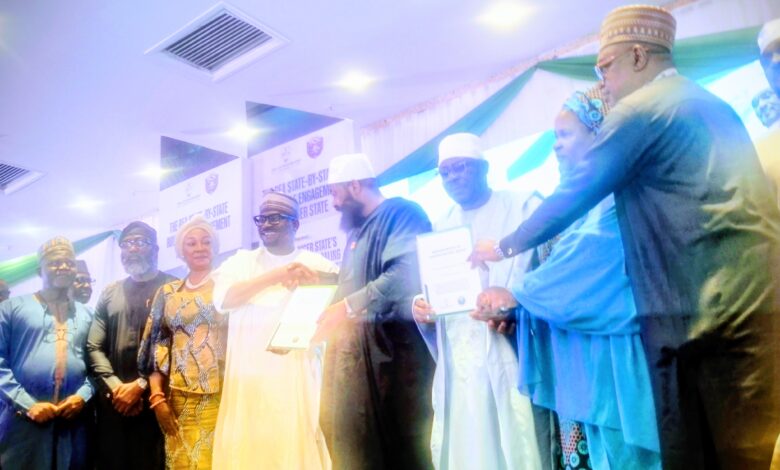
The Rural Electrification Agency (REA) and the Niger State Government on Thursday in Abuja signed a Memorandum of Understanding (MoU) to accelerate the deployment of distributed renewable energy solutions across the state, as stakeholders converged for the 23rd State-by-State Roundtable Engagement aimed at unlocking Niger State’s energy potential and driving broad-based social and economic growth.
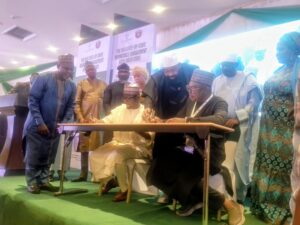
Delivering a special address, Governor Mohammed Umaru Bago of Niger State, popularly called The Farmer’s Governor, emphasised sustainability as the central test of energy interventions, arguing that projects must endure beyond political tenures through resilient institutions, productive infrastructure and sincere policy execution.
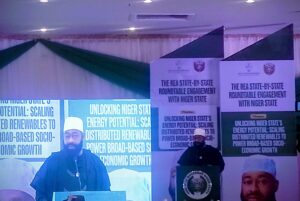
“Sustainability is about continuity after leadership. You must build institutions that are resilient and faceless, able to adapt to every time and every regime,” Bago said.
The governor linked power access to economic productivity, warning that social services without livelihoods are not financially sustainable. He stressed that electricity must drive production in agriculture, housing, health and industry to generate incomes that support service delivery and repayment.
Bago disclosed that Niger State has committed 100,000 hectares of land for housing and agriculture under a flagship investment programme, noting that renewable energy deployment across such developments would underpin mortgages, jobs and value chains. He also announced the state’s readiness to co-invest with private partners on a dollar-for-dollar basis, offer tax incentives and fast-track approvals to accelerate projects.
Highlighting Niger State’s resource endowment, the governor said the state hosts significant silicon deposits for solar manufacturing and large lithium reserves critical for battery production, inviting global manufacturers to establish local solar cell and battery plants. He added that Niger State is transitioning public hospitals, schools and offices to green power, supported by a dedicated Green Agency to drive the green economy.
On skills and jobs, Bago revealed the creation of a Ministry of Vocational and Technical Education to ensure renewable investments translate into local employment and technology transfer. He also cited progress at IBB University, Lapai, where a 5.5MW solar plant with 7.5MWh battery storage is strengthening campus power security and expanding capacity.
Setting the tone earlier, REA Managing Director/CEO, Abba Aliyu, said Nigeria faces a stark electricity access challenge, with over 86 million people, many in northern states, still without power. He noted that extending the national grid to sparsely populated and remote communities is often uneconomic, making mini-grids and solar home systems the most viable solutions.
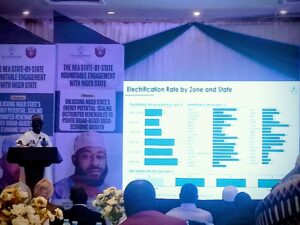
Aliyu explained that President Bola Tinubu’s approval of $750 million for renewable electrification, the largest publicly funded programme of its kind, aims to catalyse private investment to deliver 1,350 mini-grids and electrify 17.5 million Nigerians. REA, he said, now has about $1.2 billion available for deployment, with an additional $2.6 billion financing pipeline.
He added that the Electricity Act 2023 has decentralised power, empowering states and even local governments to shape their electricity futures, while REA’s national electrification data maps guide cost-effective technology choices community by community.
The roundtable concluded with commitments to deepen collaboration between REA and Niger State, accelerate bankable renewable projects, and scale distributed energy solutions that support production, jobs and long-term growth, aligning with the national goal of transitioning communities “from darkness to light.”
For further enlighment, Aminu Suleman Takuma, Commissioner for Investment highlighted that the Niger State Government’s collaboration with the Ministry of Finance and the Rural Electrification Agency (REA) to drive sustainable development and expand access to electricity across underserved communities.
Takuma praised the swift implementation of the Sustainable, Integrated and Protective Community (SIPC) initiative, noting that within two weeks of its launch, the state government had processed certificates of occupancy for 100,000 hectares of land donated by the governor to support the project.
In overview REA community mapping, Mohammed Jibrin, the Technical Advisor, disclosed that Nigeria currently has an electricity access rate of about 60 per cent, leaving more than 86 million people without power, a significant number of whom reside in northern states,
He explained that extending national transmission lines to sparsely populated rural areas is often uneconomical, making renewable and distributed energy solutions such as mini-grids and solar home systems the most viable option. “To address this gap, the Federal Government has approved $750 million for renewable energy projects, aimed at electrifying 17.5 million Nigerians through the deployment of over 1,300 mini-grids, while also empowering states under the Electricity Act 2023 to take charge of their power sectors.”
READ ALSO: Jeffrey Daniel Urges Africans in Diaspora to Reconnect, Relocate to Africa
In Niger State, the REA revealed that detailed data-driven planning has identified more than 3,500 communities suitable for electrification interventions, with ongoing projects set to inject about 20 megawatts of fresh capacity and connect over 69,000 households.
The agency projected that, if fully harnessed, renewable energy opportunities in the state could attract up to $1.2 billion in investment, boost the state’s economy significantly, and create hundreds of thousands of jobs. Stakeholders reaffirmed their commitment to partnering with the state government to position Niger State as a leading hub for mini-grid development in Nigeria.
About The Author