
By Fatima Saka
The Federal Government has recorded significant progress in key health indicators, including immunisation coverage and maternal health outcomes, as part of ongoing reforms to strengthen Nigeria’s healthcare system.
As its unveiled the National Health Facility Survey (NHFS) 2025, aimed at strengthening data-driven planning and improving health workforce development
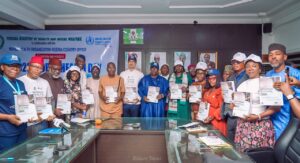
Speaking at the ministerial press briefing in Abuja on Tuesday to commemorate the 2026 World Health Day, Minister of State for Health and Social Welfare, Dr. Iziaq Adekunle Salako, disclosed that over 14 million girls have been vaccinated against HPV, while more than 102 million children have received the measles-rubella vaccine, achieving about 99 per cent coverage nationwide.
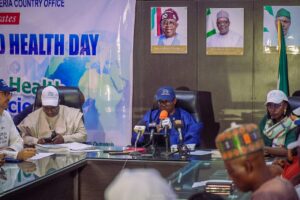
He added that utilisation of primary healthcare services has risen sharply from about 10 million visits in early 2024 to 45 million by mid-2025, reflecting increased public confidence in the system.
On maternal health, the minister revealed that targeted interventions under the Maternal Mortality Reduction Innovation Initiative have led to a 17 per cent reduction in maternal deaths in participating facilities.
He noted that over 232 comprehensive emergency obstetric centres have been upgraded, providing services to more than 16 million women and nearly two million newborns.
Salako further disclosed that over 21.7 million Nigerians are now enrolled in health insurance schemes, representing a 33 per cent increase since late 2023, in a bid to reduce out-of-pocket healthcare spending.
The minister reaffirmed the Federal Government’s commitment to achieving universal health coverage through science-driven policies, increased investment, and strategic partnerships.
He noted that the annual observance, led by the World Health Organization, provides an opportunity to reflect on global health challenges and reinforce commitments to improving public health outcomes.
Highlighting this year’s theme, “Together for Health: Stand with Science,” Salako stressed the importance of evidence-based policymaking, scientific innovation, and collaboration in addressing both infectious and non-communicable diseases.
The minister reaffirmed the commitment of the administration of Bola Ahmed Tinubu to prioritising healthcare under the Renewed Hope Agenda, describing health as a fundamental human right and a critical pillar of national development.
Salako acknowledged persistent challenges in the sector, including workforce shortages, migration of skilled professionals, inadequate power supply in health facilities, and reliance on imported medical supplies.
He also cited the dual burden of infectious diseases such as malaria, tuberculosis, and HIV, alongside rising cases of non-communicable diseases like hypertension, diabetes, and cancer.
Despite these challenges, “the government is implementing comprehensive reforms under the Nigeria Health Sector Renewal Investment Initiative to improve financing, strengthen institutions, and enhance service delivery”, he said.
He commended agencies such as the Nigeria Centre for Disease Control and Prevention for strengthening outbreak preparedness and response, particularly in managing Lassa fever outbreaks, and the National Agency for Food and Drug Administration and Control for ensuring the safety and quality of medicines and vaccines.
Salako also highlighted the role of private sector participation through the Presidential Initiative for Unlocking the Healthcare Value Chain, aimed at boosting local pharmaceutical production and reducing import dependence.
He underscored the growing role of technology through the Nigeria Digital-in-Health Initiative, which is driving the adoption of telemedicine, electronic health records, and data-driven decision-making.
In her welcome address, Permanent Secretary of the Federal Ministry of Health and Social Welfare, Daju Kachollom, said the event provides a platform to assess progress, renew commitments, and strengthen collaboration toward improved national health outcomes.
She emphasised that World Health Day highlights the importance of health as a foundation for economic growth, social stability, and human dignity, while commending partners, civil society, and the media for their continued support.
Also speaking, WHO Country Representative, Dr. Pavel Ursu, stressed the importance of science in advancing global health, noting that vaccination alone has saved over 150 million lives worldwide.
READ ALSO: 2027: Ugokwe Unveils Economic, Youth-Focused Agenda for Anambra Central Senate Race
He acknowledged Nigeria’s progress in immunisation, primary healthcare, and disease surveillance but cautioned that challenges such as limited access to essential services, maternal and child mortality, and declining trust in science persist.
Meanwhile, Abolade Surajudeen, National Coordinator and Deputy Director at the National Bureau of Statistics, underscored the importance of data-driven decision-making, noting that detailed statistics on child and adolescent health are contained in the Bureau’s official report, which will guide policymaking and support research.
About The Author